Using design patterns to build and maintain the Rule of Law

L Diver, (2024) ‘Using design patterns to build and maintain the Rule of Law’ 3(2) Digital Society 30. View online

Abstract

Law is, and has, an architecture. This article investigates that architecture by reference to the idea of ‘pattern languages’, as described in Alexander, Ishikawa, and Silverstein, A Pattern Language (OUP, 1977). Such ‘languages’ are combinations of design patterns, operating at multiple levels of abstraction and interlinking with one another to form a ‘fabric’ that constitutes the broader practice or enterprise. Applied to the legal domain, we can similarly identify patterns that operate at various levels, brought together into the idealised pattern language of legality and the Rule of Law. The article attempts to deconstruct the Rule of Law into its components. It presents two visual schemas showing those patterns and their dependencies, an initial narration of a selection of them, and example of how to ‘read’ the language. The goal is to provide a mechanism to assess which Rule of Law elements are present (or not) in a given instance, and also to identify what was absent in cases where we feel the ideal has failed to live up to its promise. It is also intended to contribute to the development of ‘legal tech’, by offering a mechanism of translation between Rule of Law values and software development practice. Ultimately, the goal is to foster legal and digital architectures that respect, sustain, and even strengthen legality and the Rule of Law.

(Open access pre-print here: https://osf.io/preprints/socarxiv/587zd. The publisher’s final version is available here)
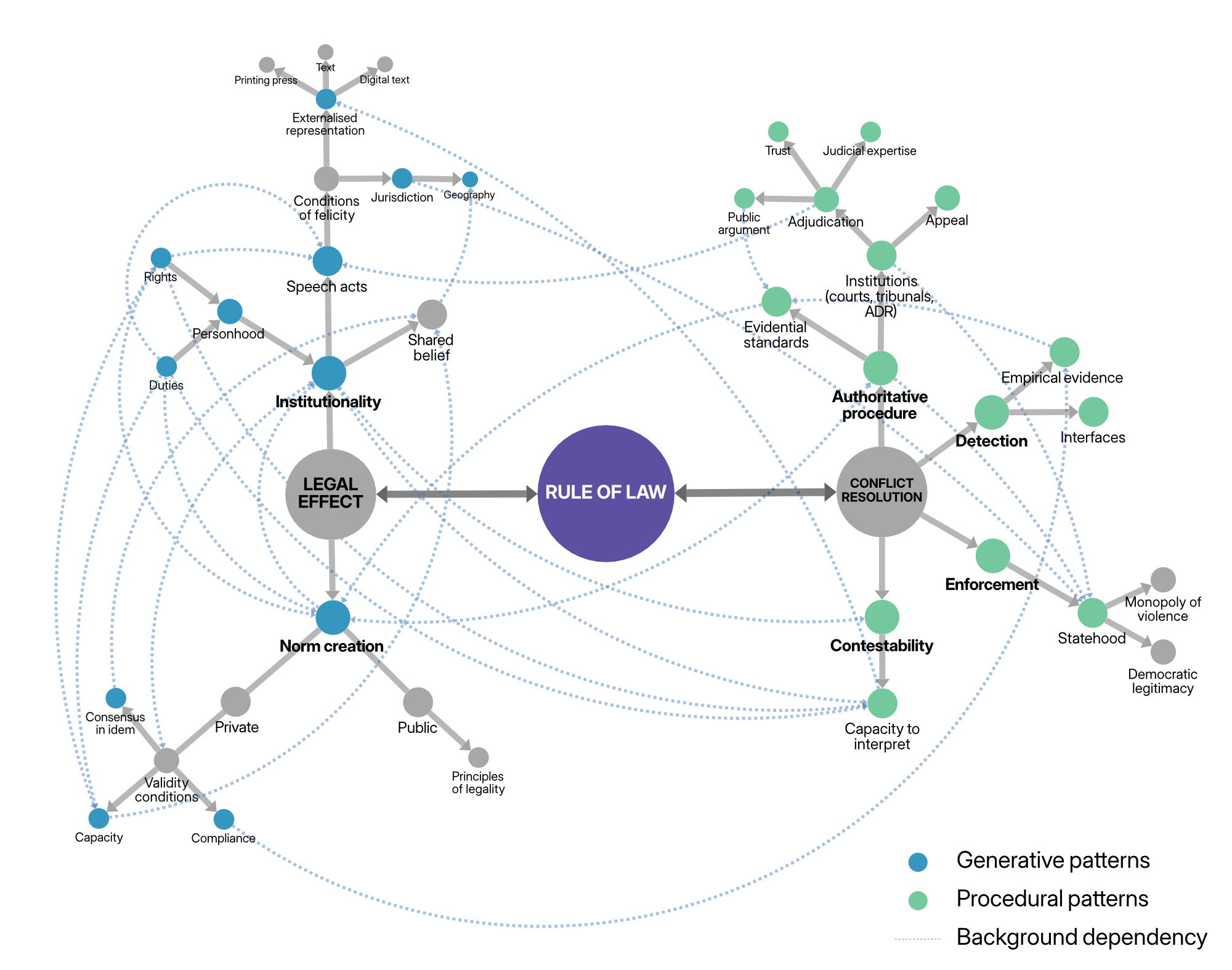
A graph schema representation of the Rule of Law's architecture

Research Study on Computational Law

P McBride and L Diver, (2024) ‘Research Study on Computational Law’ (COHUBICOL). View online

Last month I published the COHUBICOL project’s final Research Study on Computational Law, written by Pauline McBride and myself. We focus on both data-driven and code-driven legal technologies (specifically Rules as Code in the latter case), synthesising the primary research we did for the Typology of Legal Technologies with the theory of the Rule of Law, affordance and Science and Technology Studies (STS).

Read more

Legal Technologies and the Effect on Legal Effect

In February 2023 I was invited to a research seminar at the University of Helsinki’s Legal Tech Lab.

The title of my talk was “Legal Technologies and the Effect on Legal Effect”. The talk was about the concept of ‘legal effect’, which is core to the nature of what law is and how it works, and how legal technologies might have an impact on that concept.

It connects in with all the theoretical work I’ve been doing with COHUBICOL, with a practical and forward-looking twist: how do actual technologies and digital systems mediate the force and the nature of law? This research interest goes right back to the first publication from my PhD, ‘Law as a User: Design, Affordance, and the Technological Mediation of Norms’.

Challenges of mapping 'legal effect' into the computational domain
Some challenges of mapping 'legal effect' into the computational domain.

Typology of Legal Technologies

L Diver, P McBride, M Medvedeva, et al., (2022) ‘Typology of Legal Technologies’ (COHUBICOL). View online

Abstract

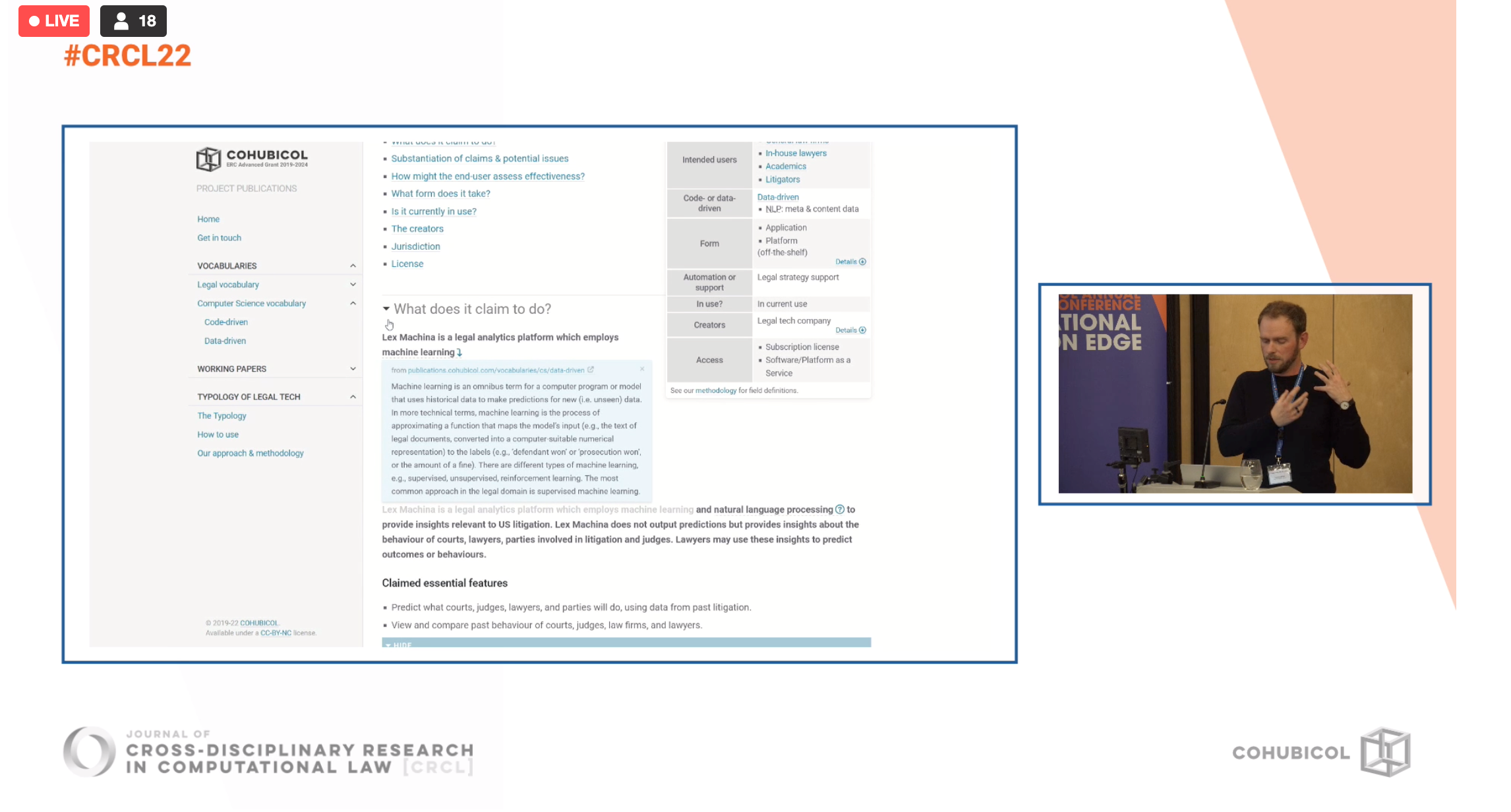
The Typology is an online, interactive publication, a methodology, and a mode of analysis. Substantively, it contains a curated set of typical legal technologies (applications, scientific papers, and datasets). The COHUBICOL team assessed these based on the claims made by their developers and/or providers, and on the substantiation of those claims, with an eye to the kind of legal impact their deployment might have. Our particular focus is on systems that might alter or impact the concept of legal effect that lies at the heart of law-as-we-know-it.

Me presenting the Typology of Legal Technologies at the CRCL22 conference
Me presenting the Typology of Legal Technologies at the CRCL22 conference.
Watch a recording here.

Argument by Numbers: The Normative Impact of Statistical Legal Tech

L Diver and P McBride, (2022) ‘Argument by Numbers: The Normative Impact of Statistical Legal Tech’ Communitas. View online

Abstract

The introduction of statistical ‘legal tech’ raises questions about the future of law and legal practice. While technologies have always mediated the concept, practice, and texture of law, a qualitative and quantitative shift is taking place: statistical legal tech is being integrated into mainstream legal practice, and particularly that of litigators. These applications – particularly in search and document generation – mediate how practicing lawyers interact with the legal system. By shaping how law is ‘done’, the applications ultimately come to shape what law is. Where such applications impact on the creative elements of the litigator’s practice, for example via automation bias, they affect their professional and ethical duty to respond appropriately to the unique circumstances of their client’s case – a duty that is central to the Rule of Law. The statistical mediation of legal resources by machine learning applications must therefore be introduced with great care, if we are to avoid the subtle, inadvertent, but ultimately fundamental undermining of the Rule of Law. In this contribution we describe the normative effects of legal tech application design, how they are potentially (in)compatible with law and the Rule of Law as normative orders, particularly with respect to legal texts which we frame as the proper source of ‘lossless law’, uncompressed by statistical framing. We conclude that reliance on the vigilance of individual lawyers is insufficient to guard against the potentially harmful effects of such systems, given their inscrutability, and suggest that the onus is on the providers of legal technologies to demonstrate the legitimacy of their systems according to the normative standards inherent in the legal system.

AI & the compression of law

Updating Wendell Holmes

Last month I had the privilege of being invited to deliver a talk to the Catalan Center for Legal Studies and Specialised Training, a centre for judicial training in Barcelona. The title of talk was ‘AI & the compression of law’, and in it my goal was to debunk the idea of the ‘robot judge’ (always depicted as a glassy white robot figure, either with a blindfold or the scales of justice). Instead, I argued, the worry with the use of AI in law is not the replacement of judges, but rather the subtle reshaping of their activities (and those of other parties in the litigation sphere) by systems whose machine learning underpinnings are geared toward a form of optimisation and relevance that are not necessarily compatible with legal notions of optimality or relevance.

Read more

Response to the Scottish Government's consultation on legal services regulation reform

This response was written in December 2021 with Pauline McBride and submitted to the Scottish Government’s Consultation on legal services regulation reform.


Written submission from Dr. Pauline McBride1 and Dr. Laurence Diver.2

This submission is made in a personal capacity and not on behalf of any of the organisations with which we are affiliated.

We are pleased to have an opportunity to the make a written submission to the Scottish Government Consultation on Legal Services Regulation Reform in Scotland. Our submission is structured as follows: in Section 1 we highlight the importance of the independence of the legal profession for the rule of law; in Section 2 we express concerns about the assumptions and limitations of the consultation document and the Roberton report on which it is based; in Section 3 we flag concerns about funding for the Roberton and Market Regulator models; finally, in Section 4, we highlight the need for more careful consideration of the specific characteristics of legal tech and what these mean in terms of appropriate regulation.

  1. LLB (Hons), DipLP, PhD; solicitor; post-doctoral researcher, Vrije Universiteit Brussel: Counting as a Human Being in the Era of Computational Law (cohubicol.com), member of the Technology Committee of the Law Society of Scotland. 

  2. LLB (Hons), DipLP, PGDip, LLM, PhD; post-doctoral researcher, Vrije Universiteit Brussel: Counting as a Human Being in the Era of Computational Law (cohubicol.com). 

Read more

Digisprudence: about the book

Written for the Edinburgh University Press blog (Dec 2021)

Tell us a bit about your book

Digisprudence is about the technologies that govern our behaviour, and how they can be designed in ways that are compatible with democracy. We’ve probably all had that feeling of frustration when using our smart phone or a website, that we’re in some sense being controlled or manipulated in what we are able to do. That might seem unimportant, but technology is powerful: imagine a car that won’t go faster than 70mph, no matter how hard you accelerate (even to avoid an accident or to get someone to hospital). Or think about the convoluted process you have to go through to delete your Facebook account, especially if you want it to happen immediately (this could have significant implications in the case of doxxing, or other forms of online harassment).

Read more

Digisprudence: The Design of Legitimate Code

L Diver, (2021) ‘Digisprudence: The Design of Legitimate Code’ 13(2) Law, Innovation and Technology. View online

Abstract

This article introduces digisprudence, a theory about the legitimacy of software that both conceptualises regulative code’s potential illegitimacies and suggests concrete ways to ameliorate them. First it develops the notion of computational legalism – code’s ruleishness, opacity, immediacy, immutability, pervasiveness, and private production – before sketching how it is that code regulates, according to design theory and the philosophy of technology. These ideas are synthesised into a framework of digisprudential affordances, which are translations of legitimacy requirements, derived from legal philosophy, into the conceptual language of design. The ex ante focus on code’s production is pivotal, in turn suggesting a guiding ‘constitutional’ role for design processes. The article includes a case study on blockchain applications and concludes by setting out some avenues for future work.

Interpreting the Rule(s) of Code: Performance, Performativity, and Production

L Diver, (2021) ‘Interpreting the Rule(s) of Code: Performance, Performativity, and Production’ MIT Computational Law Report. View online

Abstract

Software code is built on rules, and the way it enforces them is analogous in certain ways to the philosophical notion of legalism, under which citizens are expected to follow legal rules without thinking too much. The ontological characteristics of code – its opacity, immutability, immediacy, pervasiveness, private production, and ‘ruleishness’ – amplify its ‘legalistic’ nature far beyond what could ever be imposed in the legal domain, however, raising significant questions about its legitimacy as a regulator. This contribution explores how we might critically engage with the text of code, rather than just the effects of its performance, in order to temper these extremes with the reflexive wisdom of legality. This means contrasting the technical performance of code with the social performativity of law, demonstrating the limits of viewing the latter as merely a regulative ‘modality’ that can be easily supplanted by code. The latter part of the article considers code and the processes and tools of its production from the perspective of legality, drawing on theories of textual interpretation, linguistics, and critical code studies. The goal is to consider to what extent it might be possible to guide that production, in order to ameliorate an ingrained ‘legalism’ that is democratically problematic.

Computational Legalism and the Affordance of Delay in Law

L Diver, (2020) ‘Computational Legalism and the Affordance of Delay in Law’ 1(1) Journal of Cross-disciplinary Research in Computational Law. View online

Abstract

Delay is a central element of law-as-we-know-it: the ability to interpret legal norms and contest their requirements is contingent on the temporal spaces that text affords citizens. As computational systems are further introduced into legal practice and application, these spaces are threatened with collapse, as the immediacy of ‘computational legalism’ dispenses with the natural ‘slowness’ of text.

Read more

Aid and AI: The Challenge of Reconciling Humanitarian Principles and Data Protection

J Zomignani Barboza, L Jasmontaitė-Zaniewicz, L Diver, (2020) ‘Aid and AI: The Challenge of Reconciling Humanitarian Principles and Data Protection’ Privacy and Identity 2019: Privacy and Identity Management. Data for Better Living: AI and Privacy 161. View online

Abstract

Artificial intelligence systems have become ubiquitous in everyday life, and their potential to improve efficiency in a broad range of activities that involve finding patterns or making predictions have made them an attractive technology for the humanitarian sector. However, concerns over their intrusion on the right to privacy and their possible incompatibility with data protection principles may pose a challenge to their deployment.

Read more

Technological mediation vs. the Rule of Law

Model of a man climbing a ladder amongst wire cubes

Presented at the conference on the Philosophy of Human-Technology Relations (PHTR), November 2020

Abstract

In a constitutional democracy, the operation of law relies on the multi-interpretability of language and the possibility of contesting meaning. These capabilities are assumed in the contemporary structures of rule creation, interpretation, adjudication, and enforcement. When new technologies are introduced into those structures, such as AI/machine learning or self-executing rules (e.g. smart contracts), new mediations necessarily enter the frame.

Read more

Computational Legalism vs. Critical Code Studies

Screenshot of a slide showing 'Hello world' in various programming languages

Presented in the ‘slow science’ series at LSTS, the ideas in this presentation were the basis for the paper Interpreting the Rule(s) of Code: Performance, Performativity, and Production (2021)

Abstract

Computational legalism refers to the ontological features of digital systems that make it impossible for humans to see, interpret, and contest the rules that they contain and impose. When software code structures our behavioural possibilities, it forces us to act ‘legalistically’, that is, like automatons: we don’t think, but simply act in accordance with the structures laid down by the code, because we have no other choice (unless the system’s designer has elected to give us one). This paper/discussion seeks to view and challenge computational legalism through the lens of critical code studies, the explication of a digital system’s meaning by the interpretive or hermeneutic analysis of its text, i.e. its source code. These texts play a fundamental role in the constitution of all digital systems, and so any analysis cannot be complete without at least some engagement at that level. Looking at digital systems from this angle is relevant to real-world processes of designing and producing code, and might help us to identify normative possibilities for combatting the vices of computational legalism.

Computational Legalism

Do not enter sign

(Originally posted on the COHUBICOL research blog.)

This post summarises computational legalism, a concept I developed in my doctoral thesis that is borne of the parallel between code’s ruleishness – its reliance on strict, binary logic instead of interpretable standards – and its conceptual equivalent in the legal realm, known as legalism (more specifically the strong variant of the latter).

Read more

Normative Shortcuts and the Hermeneutic Singularity

Photo of tools

(Originally posted on the COHUBICOL research blog.)

Legal normativity is an important theme for COHUBICOL, particularly how its nature might change when the medium that embodies it moves from text to code- and data-driven systems. Normativity is a useful concept in thinking about the role of law and of legal systems; it refers to the purposive force of (textual) legal instruments and rulings that, subject to their interpretation and potential contestation, require citizens to act (or not act) in certain ways.

Read more

Law as a User: Design, Affordance, and the Technological Mediation of Norms

L Diver, (2018) ‘Law as a User: Design, Affordance, and the Technological Mediation of Norms’ 15(1) SCRIPTed 4. View online

Abstract

Technology law scholars have recently started to consider the theories of affordance and technological mediation, imported from the fields of psychology, human-computer interaction (HCI), and science and technology studies (STS). These theories have been used both as a means of explaining how the law has developed, and more recently in attempts to cast the law per se as an affordance. This exploratory paper summarises the two theories, before considering these applications from a critical perspective, noting certain deficiencies with respect to potential normative application and definitional clarity, respectively.

Read more

The law as (mere) user: affordance and the mediation of law by technological artefacts

Presented at TRILcon, University of Winchester, April 2018. This paper was later published as Law as a User: Design, Affordance, and the Technological Mediation of Norms.

Abstract

Technology law scholars have recently begun to consider the design studies concept of affordance, bringing it into the legal fold both as a means to explain how the law has developed the way it has,[1] and more recently in attempts to cast the law per se as an affordance.[2]

Read more

Digisprudence: developing a legal-theoretical approach to compliance by design

Presented at BILETA 2018, University of Aberdeen.

Abstract

The literature concerning the regulation of technology is rightly beginning to focus more on ex ante, or ‘by design’, enforcement. Despite almost two decades having passed since Lawrence Lessig’s Code was first published, the acceptance that ‘code’ (as opposed to law) has the power to regulate, and an appreciation of that power, is still developing, particularly since it requires a level of interdisciplinary openness to which the conservative legal world is occasionally hostile.

Read more

Opening the Black Box: Petri Nets and Privacy by Design

L Diver and B Schafer, (2018) ‘Opening the Black Box: Petri Nets and Privacy by Design’ 31(1) International Review of Law, Computers & Technology 68. View online

Abstract

Building on the growing literature in algorithmic accountability, this paper investigates the use of a process visualisation technique known as the Petri net to achieve the aims of Privacy by Design. The strength of the approach is that it can help to bridge the knowledge gap that often exists between those in the legal and technical domains. Intuitive visual representations of the status of a system and the flow of information within and between legal and system models mean developers can embody the aims of the legislation from the very beginning of the software design process, while lawyers can gain an understanding of the inner workings of the software without needing to understand code. The approach can also facilitate automated formal verification of the models’ interactions, paving the way for machine-assisted privacy by design and, potentially, more general ‘compliance by design’. Opening up the ‘black box’ in this way could be a step towards achieving better algorithmic accountability.

From privacy impact assessment to social impact assessment

L Edwards, D McAuley, L Diver, (2016) ‘From privacy impact assessment to social impact assessment’ IEEE Security and Privacy Workshops (SPW) 53. View online

Abstract

In order to address the continued decline in consumer trust in all things digital, and specifically the Internet of Things (IoT), we propose a radical overhaul of IoT design processes. Privacy by Design has been proposed as a suitable framework, but we argue the current approach has two failings: it presents too abstract a framework to inform design, and it is often applied after many critical design decisions have been made in defining the business opportunity. To rebuild trust we need the philosophy of Privacy by Design to be transformed into a wider Social Impact Assessment and delivered with practical guidance to be applied at product/service concept stage as well as throughout the system’s engineering.

Monkeying Around with Copyright – Animals, AIs and Authorship in Law

D Komuves, JN Zatarain, B Schafer, L Diver, (2015) ‘Monkeying Around with Copyright – Animals, AIs and Authorship in Law’ Internationales Rechtsinformatik Symposion (IRIS) 26. View online

Abstract

Advances in artificial intelligence have changed the ways in which computers create “original” work. Analogies that may have worked sufficiently well in the past, when the technology had few if any commercially viable applications, are now reaching the limit of their usefulness. This paper considers particularly radical thought experiment in relation to computer generated art, challenging the legal responses to computer generated works and discussing their similarity to works by animals.

A fourth law of robotics? Copyright and the law and ethics of machine co-production

B Schafer, D Komuves, JMN Zatarain, L Diver, (2015) ‘A fourth law of robotics? Copyright and the law and ethics of machine co-production’ 23(3) Artificial Intelligence and Law 217. View online

Abstract

Jon Bing was not only a pioneer in the field of artificial intelligence and law and the legal regulation of technology. He was also an accomplished author of fiction, with an oeuvre spanning from short stories and novels to theatre plays and even an opera. As reality catches up with the imagination of science fiction writers who have anticipated a world shared by humans and non-human intelligences of their creation, some of the copyright issues he has discussed in his academic capacity take on new resonance. How will we regulate copyright when robots are producers and consumers of art? This paper tries to give a sketch of the problem and hints at possible answers that are to a degree inspired by Bing’s academic and creative writing.

Would the current ambiguities within the legal protection of software be solved by the creation of a sui generis property right for computer programs?

L Diver, (2008) ‘Would the current ambiguities within the legal protection of software be solved by the creation of a sui generis property right for computer programs?’ 3(2) Journal of Intellectual Property Law & Practice 125. View online

Abstract

Legal context: Software is an anomaly in the traditional sphere of IP, and its problematic nature has been manifest in the confused findings of courts on both sides of the Atlantic. This article considers the reasons for the confusion, where things might have been done better, and how the law could develop considering the realities of the industry.

Key points: Software protection at present favours the multinational corporations, while the interests of smaller companies and the Free and Open Source Software community are prejudiced greatly. The current regime is not fundamentally incompatible with software, however, and as such features of it could and should be retained in the creation of a sui generis IP right.

Practical significance: Much of today’s software industry is driven by the efforts of small enterprises and the Free and Open Source Software community. Their interests are not recognized in the current protection-biased framework, and as a result innovation is being stifled by the threat of litigation. IP law in this area is preventing the very thing it is designed to foster—enterprise and innovation.